
Where to see hydrangea in Japan
Hydrangea season in Japan is peaking right now as of early June 2026. Across most of Honshu the window is 11–30 June; Okinawa already finished, Hokkaido runs into July. The 26 most-saved spots on pathhog cluster around Kamakura, Kansai, and the Hakone train corridor, sorted below by trip shape rather than ranking.
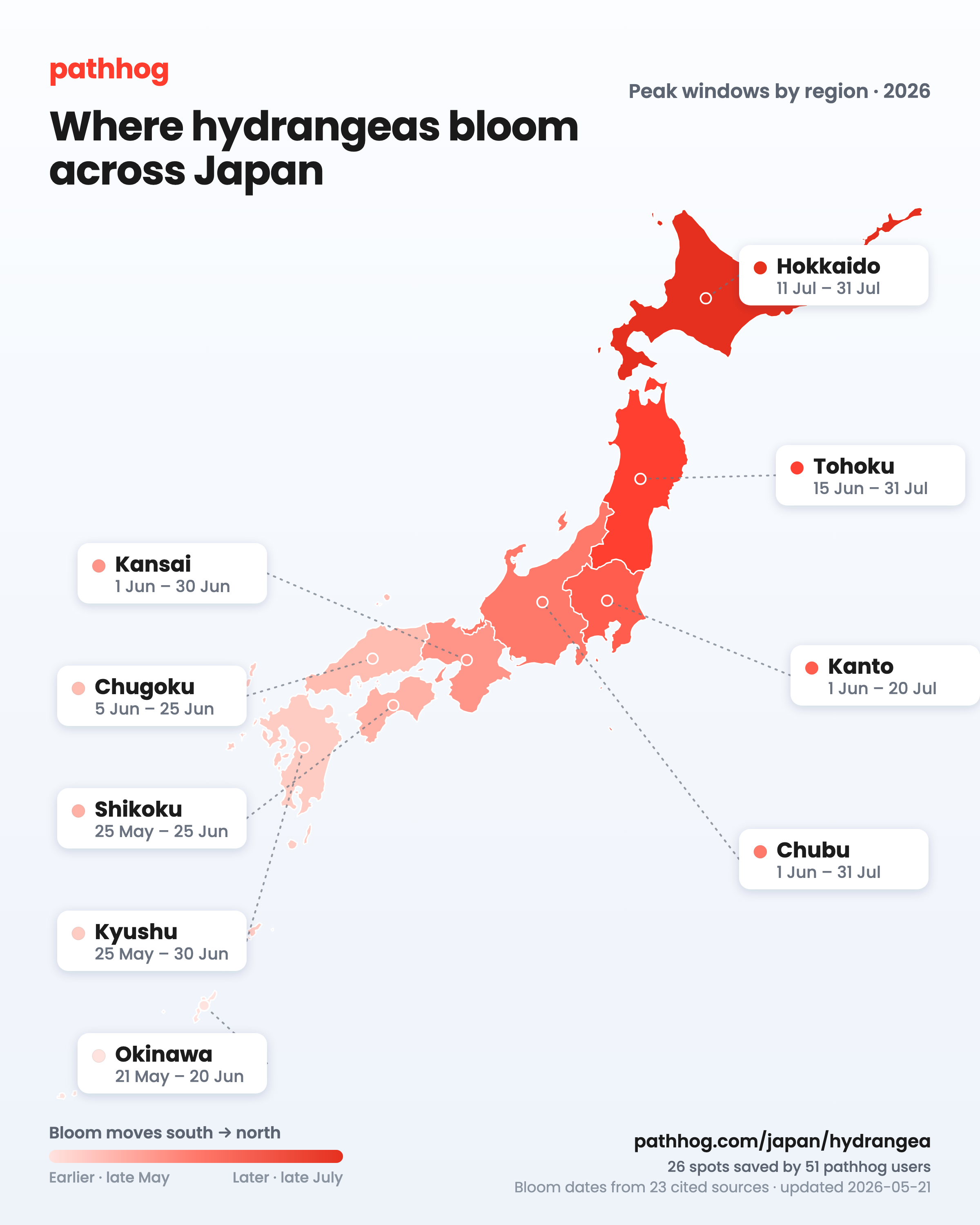
| Region | Cities | Spots | Peak start | Peak end |
|---|---|---|---|---|
| Okinawa | Motobu | 1 | 21 May | 20 Jun |
| Kyushu | Karatsu, Miyakonojo, 門川町, +1 | 4 | 25 May | 30 Jun |
| Kansai | 宇治, Nagaokakyo, Tsu | 3 | 1 Jun | 30 Jun |
| Chubu | Mishima, Fujikawaguchiko, Fukuroi, +3 | 6 | 1 Jun | 31 Jul |
| Kanto | 鎌倉, Kamakura, Hakone, +5 | 9 | 1 Jun | 20 Jul |
| Tohoku | Oga, 一関 | 2 | 15 Jun | 31 Jul |
| Hokkaido | Date | 1 | 11 Jul | 31 Jul |
How to plan your trip:
- Check when your dates fall. Bloom peaks slide south to north, late May into late July.
- Pick by trip shape: Kamakura for one weekend, Kansai for a temple circuit, Hakone for the train, or rare-variety farms if you’re an ajisai obsessive.
- Save your shortlist to pathhog from the interactive map at the bottom. Filter by region or week, then carry it on your phone.

If you only have one June weekend: Kamakura
Maxwell of hydrangea viewing. The three Kamakura temples sit within a 2-kilometre walk of each other and the JR train from Tokyo Station takes an hour. Second week of June is peak. Aim for 8:30am opening at Meigetsuin to beat the worst of the queue, then walk to Hasedera for the sea-view path, and finish at Jojuin if your legs hold up.
Meigetsuin Temple


The “Ajisai-dera” of Kamakura. Roughly 2,500 hydrangea bushes, mostly the pale Meigetsuin blue variety, and the temple’s circular bamboo window frames a hydrangea-filled inner garden during peak season. That window shot is what most travelers come for, and it earns its queue. Numbered admission tickets from 8:30am; the second and third weeks of June are the bottleneck.
Hasedera Temple

Open from 8am, an hour earlier than Meigetsuin, and that hour is the move. The hydrangea pathway climbs the hillside with views over Yuigahama Bay. Less hyped than Meigetsuin, just as photogenic. Pair the two and you’ve done Kamakura’s flagship ajisai trail in a morning.
Jojuin Temple

The quiet third. A 108-step staircase lined with hydrangeas, fewer tour buses, more locals. Worth the legs if you’ve already done Meigetsuin and Hasedera and want to extend the Kamakura morning without the crush.
If you want the Kansai temple circuit
If you’re spending time in Kyoto and Nara anyway, three temples here form a natural ajisai day-and-a-half. Mimuroto-ji is the scale anchor; Yokoku-ji is the styling anchor; Yatadera is the deep-cut. Train hops between them are easy.
Mimuroto-ji Temple (Uji, Kyoto)

About 20,000 hydrangea plants and over 1,200 years of history. The hillside garden is laid out so the blooms stack in tiers; you get better photographs than the Kamakura spots and more room to walk. Heart-shaped clusters are scattered through the garden as a small game for visitors to spot. Walkable from Uji Station on the JR Nara Line.
Yokoku-ji Temple (Nagaokakyo, Kyoto)

Also known as Yanagidani Kannon. The temple’s stone staircase is lined with hydrangeas in cut-flower arrangements that change every few days during the season. A deliberate floral display, not a wild garden. Day trip from Kyoto Station, less crowded than Mimuroto-ji.
Yatadera Temple (Yamatokoriyama, Nara)

Thousands of hydrangea trees on the temple grounds, in pink, blue, and purple. The “Yata Jizō” stone-carving tradition is part of the visit too. A 25-minute bus from Yamatokōriyama Station; the temple is quieter than Mimuroto-ji and the bus ride filters out casual visitors.
If you want the hydrangea train ride
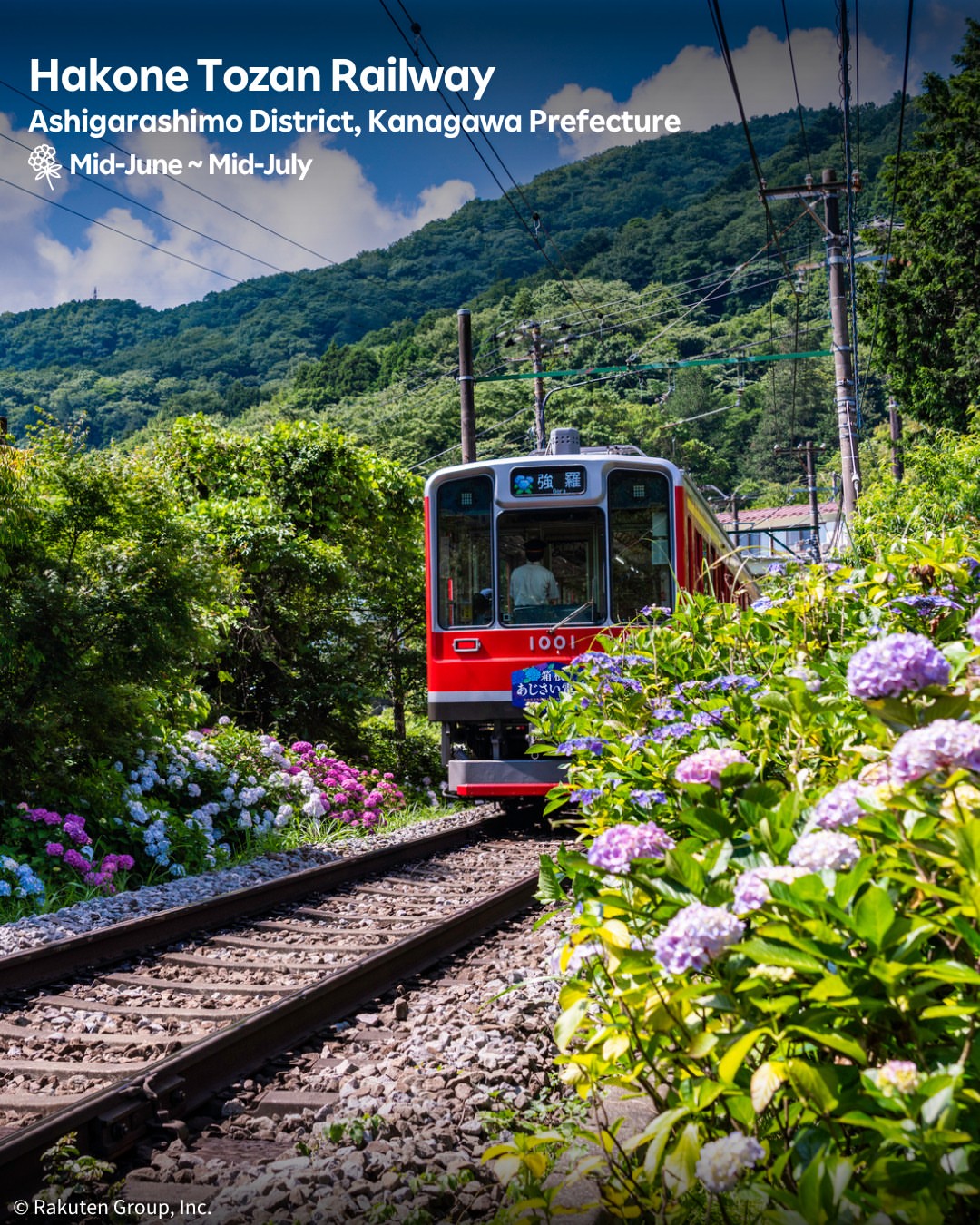
The signature June Japan experience for many travelers. The mountain railway from Hakone-Yumoto to Gora runs through a corridor of hydrangea blooms; in late June, night-illuminated trains run with reserved seating. Pair with Mishima Skywalk for a Fuji view or Myoho-ji for a mountain-temple morning.
Hakone Tozan Railway

The hydrangea train. The mountain railway from Hakone-Yumoto to Gora climbs through a corridor of blooms during June. Reserved-seat night-illuminated trains run in late June; book a few weeks ahead. Combines easily with a Hakone onsen night.
Mishima Skywalk

Japan’s longest pedestrian suspension bridge, with Mount Fuji and Suruga Bay views. Hydrangeas line the approach path in early-to-mid June. Free combo with a Mount Fuji day trip if you’re driving along the Tomei Expressway.
Myoho-ji Temple (Fujikawaguchiko, Yamanashi)

Mountain temple at the foot of Mount Fuji. Pink and purple hydrangeas with the mountain in the background when the cloud cooperates. Pair with Kawaguchiko lake views; the lake plus hydrangea plus Fuji combination is a strong June photograph.
If you want scale, rarity, or oddities
These four spots each have something the others don’t: a specialist’s collection, a single deep-blue colour, a wind-chime ritual, or sheer hillside scale.
Hattori Farm Hydrangea House (Mobara, Chiba)

Over 250 varieties of hydrangea on one farm, including rare two-toned and double-petalled types. The bloom window is brief, most of June only, and the farm is closed outside it. For ajisai enthusiasts rather than casual flower-viewers. A 90-minute train ride from central Tokyo to Mobara.
Unshoji Temple (Oga, Akita)

About 1,500 hydrangeas, almost all the same shade of deep blue. The temple is known specifically for the sea of blue effect, a single-colour scheme that doesn’t exist at any of the larger gardens. Worth the trip from Akita if you want photos that aren’t the standard pink-and-purple mix.
Hattasan Soneiji Temple (Fukuroi, Shizuoka)

About 13,000 hydrangeas and a summer ritual of hanging wind chimes through the temple grounds during the bloom. The chime sound plus the blooms makes the temple feel sensorily different from the cut-flower or pure-garden spots. Easy stop on the Tokaido Shinkansen if you’re going between Tokyo and Kyoto.
Yamanokuchi Hydrangea Garden (Miyakonojo, Miyazaki)

A southern Kyushu option for early-June bloom-chasers. 28,000 plants on a hillside with ocean views in the distance. Saved by travelers who pair it with Aoshima or Takachiho. The surrounding Miyazaki region is underrated outside Japan.
If you’ll travel after peak bloom
If your June window is late, or your trip slides into July, head north. Tohoku and Hokkaido lag the Honshu front by two to four weeks. Less crowded, longer days, and the rainy season is mostly behind you by the time the blooms catch up.
Michinoku Hydrangea Garden (Ichinoseki, Iwate)

About 2,500 plants spread across a forested ravine, peaking from late June into mid-July. A real walking garden rather than a temple display, with creeks and shade. The Tohoku Shinkansen makes Ichinoseki a feasible day or overnight from Tokyo.
Usu Zenko-ji Temple (Date, Hokkaido)

Hokkaido’s late-bloom anchor. The temple grounds peak in early-to-late July, three to four weeks behind Honshu, which means the spots that emptied out by Tanabata are still alive here. Pair with the Lake Toya / Mount Usu area for the full southwestern Hokkaido weekend.
If you’re already in Kyushu or Okinawa
Kyushu and Okinawa are the early-bloom theatre: Okinawa kicks off in mid-May, the rest of Kyushu peaks late May to mid-June. If you’re flying into Fukuoka or Naha for other reasons in late spring, fold one of these in.
Yohen Hydrangea Garden (Motobu, Okinawa)

Japan’s earliest hydrangea bloom, opening mid-May and running into June. A family-run garden in the north of Okinawa, on the same peninsula as the Churaumi Aquarium. Practical for travelers already on the island for snorkelling or aquarium trips; not worth the flight on its own.
Mikaeri Falls (Karatsu, Saga)

A waterfall framed by hydrangeas. The name 見帰り means “look back,” and the falls earn it; the trail back gives you a different angle than the trail in. Peaks in mid-June, when the rains have filled the river. Two hours by car from Fukuoka.
Cape Togenkyo (Kadogawa, Miyazaki)

Pink hydrangeas along a coastal cape with views over the Genkai Sea. A driving stop on the Miyazaki coast rather than a destination by itself. Pair with Aoshima Shrine or the Takachiho Gorge for a two-day Miyazaki loop.
Huis Ten Bosch (Sasebo, Nagasaki)

The Dutch-themed park in Nagasaki goes heavy on seasonal flower displays, with hydrangeas from late May to June. Touristy but well-executed, and the windmill-canal backdrop gives you a photograph you can’t get anywhere else in Japan. Family-friendly if that matters for the trip.
If you’re in the Tokyo / Kanto area
Tokyo proper doesn’t have famous hydrangea spots the way Kamakura does, but within an hour or two there are four worth the day trip. Hakusan Shrine has a real festival, Hondo-ji is the photographer’s pick, Amabiki Kannon has a ritual that doesn’t exist elsewhere, and Gongendo is the easy walk. All peak in the second and third weeks of June.
Hakusan Shrine (Bunkyo, Tokyo)

The shrine grounds host the annual Bunkyo Ajisai Festival in mid-June. About 3,000 hydrangea bushes. Small by garden-tour standards but the festival itself adds food stalls, kimono-wearing visitors, and a community atmosphere you don’t get at the bigger spots.
Hondo-ji Temple (Matsudo, Chiba)

A five-storied pagoda with hydrangeas in the foreground is what the temple is known for. Photographers’ favourite within Greater Tokyo. Peaks early June to July, less crowded than Kamakura, 30-minute train from Ueno.
Amabiki Kannon / Rappō-ji Temple (Sakuragawa, Ibaraki)

Floating hydrangeas in the temple’s water basins, accompanied by white ducks during the season. The ritual of cut blooms floating on water is specific to a few Japanese temples; Amabiki is one of the most committed. 90 minutes from Tokyo by train and bus.
Gongendo Sakuratsutsumi (Satte, Saitama)

A long embankment park lined with hydrangeas, peaking mid-June into July. More an open-park walk than a temple visit, useful if you’re traveling with kids or grandparents who can’t handle stone steps. Closer to central Tokyo than Kamakura.
If you want night illumination or onsen pairings
Two spots offer something the rest of the list doesn’t: a hydrangea experience after dark, or one paired with a hot-spring stay.
Katahara Spa Hydrangea (Gamagori, Aichi)

Night-illuminated hydrangea garden at the Katahara Onsen resort. Combines the bloom viewing with a hot-spring stay, which is the closest thing to a relaxed June ajisai weekend. Bookings fill out two months ahead for mid-June dates.
Otsuka Shokai-ji Historical Park (Inazawa, Aichi)

A memorial park with a quieter feel than the temple gardens. 5,000 hydrangea plants across the park grounds. Pair with Nagoya as a day trip if you’re staying central Aichi.
Kamoso Kachoen Garden Park (Kakegawa, Shizuoka)

About 10,000 hydrangeas plus irises plus an on-site cafe. More of a flower-park experience than a temple visit. Easy stop on the Tomei Expressway between Tokyo and Kyoto if you’re driving.
Map
Filter by bloom window or region. Tap a card or a pin to jump to the write-up above.
- Meigetsuin TempleBuddhist temple in Kamakura with over 2,500 hydrangea bushes and a large round window.
@japan_web_magazine
- Hasedera TempleA hilltop Buddhist temple with over 2,500 hydrangeas and panoramic views of Kamakura and Sagami Bay.
- Jojuin TempleA historic hilltop Buddhist temple with a 108-step hydrangea-lined staircase and views of Yuigahama Beach.
- Mimuroto-ji TempleAncient temple in Uji with about 20,000 hydrangea plants and a history of over 1,200 years.
- Yokoku-ji TempleHistoric temple with a colorful staircase lined with hydrangeas in Nagaokakyo, Kyoto.
- Mikaeri FallsWaterfall framed by blooming hydrangeas along a riverside trail in Karatsu, Japan.
- Hakone Tozan RailwayMountain cable car ride through lush greenery and hydrangeas in Hakone, Japan.
- Mishima SkywalkBuddhist temple with hydrangeas blooming from mid-June to July in Okayama, Japan.
- Myoho-ji TempleA temple in Fujikawaguchiko with hydrangea gardens and scenic mountain views.
- Hattori Farm Hydrangea HouseGarden in Mobara with over 250 hydrangea varieties blooming briefly in June.
- Unshoji TempleTemple in Oga with 1,500 blue hydrangeas creating a sea of flowers in season.
- Hattasan Soneiji TempleHistoric temple with 13,000 hydrangeas, wind chimes, and traditional structures in Fukuroi.
- Yamanokuchi Hydrangea GardenA hillside garden filled with about 28,000 hydrangeas in shades of purple, pink, and blue, with views of the ocean in Miyakonojo.
- Michinoku Hydrangea GardenGarden in Ichinoseki with about 2500 hydrangea plants, famous for its colorful blooms.
- Usu Zenko-ji Temple & Nature ParkTemple and nature park with hydrangeas blooming from July in Date, Japan.
- Yohen Hydrangea GardenHydrangea garden on Okinawa Island with blooms from May to June in Motobu, Japan.
 Kazahaya no SatoHillside garden by a lake featuring seasonal hydrangeas and wisteria in Tsu, Japan.
- Cape Togenkyo玄海灘の絶景とピンクのあじさいが調和した静かな観光地です。
- Huis Ten BoschTheme park with hydrangeas blooming late May to June in Sasebo, Japan.
- Hakusan ShrineSmall Shinto shrine in Tokyo with an annual hydrangea festival in June.
- Hondo-ji TempleBuddhist temple with hydrangeas blooming from early June to July in Matsudo, Japan.
- Amabiki Kannon / Amabiki-san Rappō-jiSerene Buddhist temple with water gardens featuring floating hydrangeas and white ducks, located in Sakuragawa, Ibaraki.
- Gongendo SakuratsutsumiRecreation area with hydrangeas blooming from mid-June to July in Imizu, Japan.
- Katahara Spa Hydrangea (Aji-sai no Sato at Katahara Onsen)紫陽花が咲き乱れる丘の上の庭園で、夜はライトアップされた幻想的な雰囲気を楽しめる温泉リゾートです。
- Otsuka Shokai-ji Historical ParkMemorial park with hydrangeas blooming in early summer in Inazawa, Japan.
- Kamoso Kachoen Garden ParkBotanical garden featuring over 10,000 hydrangeas and irises, with a cafe and bird displays in Kakegawa.
Bloom-date sources (23)
- JNTO: Meigetsuin Temple
- Japan Starts Here: Hydrangea Season
- Japan Guide: Kamakura Hydrangea
- Japan Guide: Mimurotoji Temple
- Japan Cheapo: Yanagidani Kannon Hydrangea Week
- Kyoto Tourism: Ajisai Spots
- Hakone Japan: Hydrangea and Tozan Train
- Mishima City Tourism
- Travely Notes: Fujikawaguchiko Hydrangea Spots
- JNTO: Hattori Hydrangea House
- Japan Travel: Hydrangea Viewing at Unshoji
- JNTO: Hattasan Soneiji Temple
- Japan Travel: Hydrangeas in Kyushu
- Iwate Official Travel Guide: Michinoku Hydrangea Garden
- GLTJP: Usu Zenkoji Temple
- Oki Social: Yohena Hydrangea Garden
- Japan Travel: Mikaeri Falls Hydrangea Festival
- Kura in Japan: Tokyo Ajisai Spots
- GLTJP: Hondo-ji 50,000 Hydrangeas
- Ibaraki Guide: Amabiki Kannon Hydrangea Festival
- Insaitama: Satte Gongendo Hydrangea Festival
- Japan Guide Live: Otsuka Shokai-ji Hydrangea Festival
- Japan Travel: Iris and Hydrangea Exhibition
FAQ
When do hydrangeas bloom in Japan?
Peak window for Honshu (Tokyo, Kyoto, Kamakura) is roughly 8 June to 5 July, weather-dependent. Okinawa starts earliest in May. Hokkaido is latest, peaking in July. Most temple gardens publish daily bloom updates on their websites in June, so check before you book.
Is Kamakura too crowded for hydrangea viewing?
Yes during the second and third weeks of June, especially on weekends. Meigetsuin issues numbered admission tickets from 8:30am. Travelers in this list often visit Hasedera first (opens 8am, sea-view path) before Meigetsuin, or skip Kamakura entirely for Mimuroto-ji in Uji.
Where is the earliest hydrangea bloom in Japan?
Yohen Hydrangea Garden in Motobu, Okinawa. Blooms start in mid-May and run into June. Useful if you’re already in Okinawa for snorkelling or visiting Churaumi Aquarium.
Can I combine hydrangea viewing with cherry blossoms?
No. Cherry blossoms peak late March to early April; hydrangeas peak June to early July. Pick one season or build two trips. The pathhog board for cherry blossoms is separate.
Which spot has the best hydrangea-and-temple photograph?
Hondo-ji in Matsudo is the photographer’s pick within Greater Tokyo, for the five-storied pagoda framed by hydrangeas. For Kyoto, Mimuroto-ji’s tiered hillside gives you depth. For a single-colour shot, Unshoji in Oga is unique with its sea-of-blue effect.
More seasonal Japan guides


Save these places on pathhog


- Sources
- @japan_web_magazine, @tokyoweekender, @rakutentravel_global, @wanderinjapan1, @emily_in_japan, @arisachw, @midori0502catwalk, @editorofliu, @matcha.camera
- Bloom timing
- Creator notes cross-referenced with Japan Meteorological Corporation seasonal forecasts
- Updated
- May 2026 · View the live board on pathhog